All semester, our class has discussed the concept of “interdisciplinarity”, or the relationship between different academic disciplines. Although I don’t always see it as the most thrilling book, Interdisciplinarity by Joe Moran has proven key to this course. Most recently, we were asked to read a chapter about the sciences, which I immediately shied away form. I’ve always had an aversion to science; I could never understand a lot of it, while it really clicked for others. I felt behind, and so once I found other subjects that I was more comfortable with, I stuck with them exclusively. It’s a very insulated way to learn, one that I’m beginning to try and grow out of. And so far, college as a whole is encouraging such a change.
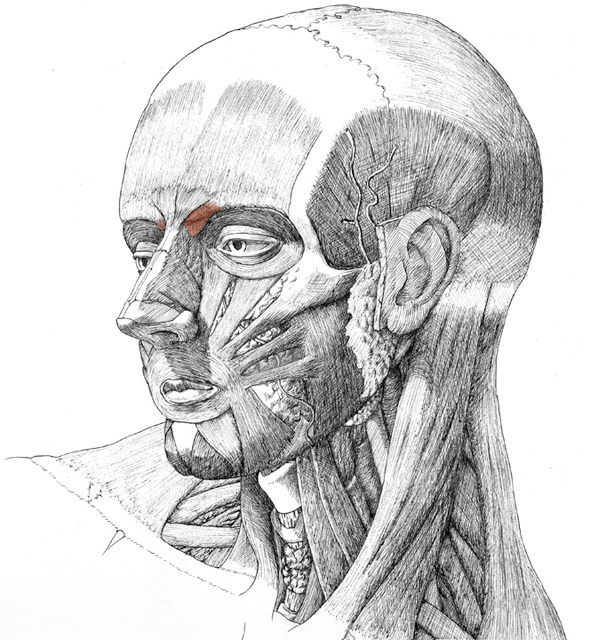
It almost seemed like fate that we had to read both “Body” by Percival Everett and the “Science, Space, and Nature” chapter in Interdisciplinarity, because I’ve recently been thinking about biology and humanities studies independently. In my “History of Drawing” course, we’ve begun our final project. It’s a self portrait, intended as the accumulation of all the strategies we’ve learned this year. However, our final lesson is to study the bone and muscle structure of the face. This is because most people try to create portraits by simply looking at a face. What actually goes on underneath is so imperative to understanding, it can’t be understated; I usually have a picture of the faces muscular structure at my side when I draw. Take the eye, for example; you’re not going to capture the individuality of someone’s face if you try to sketch their eye by sight alone. It helps immensely to study the structure of how the eye looks below the surface, and then adjust it to the particulars of an individual face. Everything looks far more accurate and natural that way. Our professor described the muscles of the face as a map, onto which we can plot the particular planes that create a unique portrait. In his discussion of this “map”, he used many specific names for muscles and bones. To be honest, I’ve forgotten almost all of them by now, but the point is that it surprised me how intensely biological art could be, although it isn’t really that surprising when you consider it in the context of Interdisciplinarity.
Interdisciplinarity argues that no subject is exclusive or contained: there’s overlap in every field of study. In the chapter “Science, Space and Nature”, Moran writes “[t]he most ambitious of these neo-Darwinian projects is Wilson’s concept of ‘consilience’…Wilson now calls for a greater collaboration ‘between scientists and philosophers, especially where they meet in the borderlands between biology, the social sciences, and the humanities” (Moran, 161). This collaborative concept is seen throughout Interdisciplinarity, and argues that less division between fields would be greatly beneficial. “Body” by Percival Everett is an example of this idea, seen through Everett’s skillful combination of literature and the sciences. The language of the poem is very biological, utilizing phrases such as “orbicularis palpebrarum” (Everett, 46). However, this sort of language occurs within the format of a poem; words like this take the place of the flowery language one may expect, and Everett makes it work. It’s not clunky or forced; despite wordy and scientific terms, the rhythm within the poem remains. The section titled “Orbicularis Palpebrarum” reads “[t]hin and pale, concentrically curving, covering the eyelids, surrounding the orbit” (Everett, 46). While Everett is talking about bone and muscle structure, the characteristics attributed to a poem remain. The poet is able to simultaneously describe the human body scientifically and appreciate its beauty artistically. Similar to the portrait discussed earlier, this appears to be an instance of the idea in the quote from Interdisciplinarity. The borders between disciplines concerning the sciences and those in the humanities have been expanded, and there is a collaboration between the two in order to create new and revolutionary works. This skillful combination of scientific language and poetry creates “Body” into a stellar representation of interdisciplinary work.
Interdisciplinarity encouraged me to open my mind to the possibility of overlap between disciplines. I think before this book (and this class), I was more unanimously opposed to any STEM study. Now, though, it’s almost exciting to spot these cross-disciplinary connections as they pop up, both inside ENG 203 and out.
http://www.blakeketchum.com/index.php/facial_muscles