
Warning: This blog post contains content relating to sensitive topics, such as murder and suicide.
This past summer, I worked in a medical examiner’s office. A medical examiner, also known as a forensic pathologist, is a medical physician who examines the bodies of people who died suddenly, unexpectedly, or violently. Their job is to determine the cause of death by conducting an autopsy on the deceased. Through this experience, I gained a plethora of knowledge in anatomy and physiology through the examination of different cases and received a glimpse of the darker side of humanity. Majority of the deceased that arrived at the office had either passed away from disease or old age. However, there were some cases where the cause of death was not natural. Cases of murder, suicide, vehicle accident, and others occasionally arrived. Police officers or family members needed the medical examiner’s help to find answers.
The human body is like a picture book. An individual’s physical appearance acts like a book cover; it informs others of what or who the person is. In a sense, it fuels the observer’s first impression about the person they are looking at. When you open a book and read the pages, you begin to unveil the story it contains. When an autopsy is performed, the medical examiner analyzes the organs, the tissues, the bones, fluids, and more. They check for anomalies and, when none can be found in the body, the doctors go back and check it over again. As a student would reread a book to fully understand the context the author is trying to establish, a medical examiner looks over the body to find answers and irregularities that might explain what happened to the deceased (“author”). Every part of the body has a story to tell and it is up to the medical examiner to piece the story together. One example of a body part that tells a sorrowful tale would be the hyoid bone.
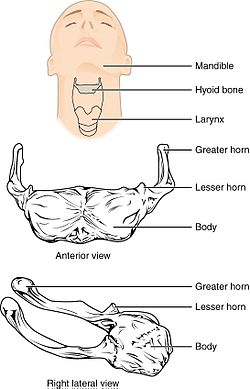
The hyoid bone is a small horseshoe-shaped bone that is situated at the anterior part of the neck between the jaw bone and the thyroid cartilage. The bone is only secured to the thyroid cartilage by ligaments. The bone functions as an attachment site for muscles that control the movement of the larynx and tongue and is involved in respiration. The larynx is located above the trachea and functions in protecting the body from choking on a foreign object. In class, we read through the section entitled after the bone I stated before, “The Hyoid Bone,” in Re: f (gesture). The text initially appeared to describe the bone itself. It is a “delicate instrument” since it takes very little pressure to fracture the bone itself. The bone is in an arch configuration and contains a “greater cornu” structure that extends out as if it is reaching past above its lesser horn.
However, the last two stanzas seem to reveal the dark story that the hyoid bone can hide from the untrained eye. Hyoid bone fractures are very rare despite its fragility because the bone is protected from damage by the surrounding tissue and bones. As a result, it is almost impossible for the fracture to occur in isolation. The most common causes of this fracture are typically physical traumas that are very violent, such as strangulation and hanging. Individuals who survive these traumas but still receive the fracture will “feel the sick pain of swallowing.” That is because the bone is no longer able to function properly. Since the larynx will not be able to close properly, there are resulting sensations of pain when ingesting food or intaking air. During my time in the medical examiner’s office, most of the cases that involved strangulation or hangings exhibited a broken hyoid bone. A fracture of any form is never pleasant or good. However, for a body to exhibit this form of fracture, it means that the body will tell a mournful tale and leave those who read it “feel the true anguish of speech.”