Are Names Crucial to Our Identity?

Everyone has a name. Whether it is something super unique, something plain, or something that’s been in the family for generations–it’s something we use to identify ourselves, and for others to identify us by.

In “Through the Looking Glass” by Lewis Carroll, Alice has an encounter with a gnat where the two talk about different names for insects. Alice admits that she has never known an insect to answer to it’s name, mainly because where she came from, insects don’t talk. The gnat asks what the use of having a name is, if one doesn’t answer to it. Here is where Alice poses her own question about identity. She says having a name is useful for those who name things and asks, “If not, why do things have names at all?”

Why do things have names? Is it because people need a way to categorize animals (and other things) to make them easier to identify? Is it to serve some sort of creative purpose, letting us express ourselves by the names we give others?

To me, names help identify individuals and serve as a symbolic contract between society and an individual. I’m sure many people could agree with this, although having a name could mean so much more…or so much less.

Just because you have a name, doesn’t necessarily mean that is the sole way to express your identity. You could be called anything else and still be you.

So do names make you who you are? I think they could be an important part of someone’s identity, but definitely not the only part. Basically, we have names so that others can address us. We have names to identify ourselves. We have names because our parents gave them to us and it’s something we’ve done for so long that we don’t even think about why we do it.

I don’t think I have a solid answer to Alice’s question, “why do we have names at all?” I can see the benefits of having a name BUT I can also see that not having a name wouldn’t really change who you are all that much.

Can I Identify As More Than One Thing?

The passage I chose was from “Alice’s Adventures In Wonderland,” by Lewis Carroll. I chose this because I thought the interaction between Alice and the Pigeon provided a lot of interesting ideas about identity. A question the passage raises is, “Is it possible to identify as more than one, singular thing?” At first, Alice was strongly arguing that she’s a little girl and the Pigeon was strongly arguing that she’s a serpent. Both were maybe right, but she clearly wasn’t fully either. The word, “identity,” means “sameness, oneness, state of being the same.” This is what identity means in the real world, but everything in Wonderland always the opposite, so she’s not used to the idea that her identity could change. Alice was arguing that she was still a little girl, even with the number of changes she had gone through that day. Hence, it is important to her that her identity stays the same; she is still holding onto the idea of being a little girl. This reflects her opposition to change, as she completely denies that she may be a serpent. She’s unwilling to look at the new facts presented to her, her appearance, and adjust to those new changes. 

This question comes to be because the serpent suggests that she may be a little girl, but she’s definitely a type of serpent. When Alice argues that little girls also eat eggs, he responds, “if they do, why they’re a kind of serpent, that’s all I can say.” With the Pigeon characterizing her as both a little girl and a type of serpent, that can help to answer the question that has been raised here because the Pigeon is suggesting that she can be a little girl and a type of serpent at the same time. Alice ponders on this idea for a few minutes. This is significant because it has her questioning if she can be more than one thing and fit into other categories than she previously thought. At the beginning of the passage, she was denying completely that she was a serpent of any kind, but by the end she was considering it to be a possibility. Both can enjoy an egg, and based on her appearance, it’s a possibility that she became a hybrid of the two. The passage attempts to answer this question with Alice considering that she can possibly be more than one thing. Since she’s supposed to be seen as one of the only rational characters in the story, the fact that she’s actually considering it proves that it could be possible to be more than one thing, contrary to what she originally thought.

I also find it interesting how this passage also incorporates the idea that people are obsessed with labels, which I think is very relevant in today’s time. At first, both the Pigeon and Alice were very close-minded, arguing strongly for each of their views on what Alice should be labeled as. Since in Wonderland there are no rules as to what can happen, it’s very possible to identify as more than one thing, as it happened to Alice. This can also pertain to real life because as people, we are all trying to find who we are in our identity and express that to the world. However, there are many characteristics that make up a person, and to just focus on one is rather silly. For instance, the Pigeon stated that Alice had to be a serpent because she likes eggs. This is problematic because of the close-minded thinking. As Alice points out, that quality also applies to little girls, as they too enjoy eating eggs. Thus, I think the passage raised very compelling ideas as to how a person identifies himself or herself and explains that it’s a lot more complicated than pointing out one attribute, while ignoring all other qualities a person may have.

What’s in a Name?

The Alice books written by Lewis Carroll have a theme of identity that recurs throughout both novels. One such question of identity is in the use of a name. What is the purpose of a name? What is the relationship between a name and what it identifies? A particular passage of Lewis Carroll’s Through the Looking-Glass presents this question to the reader as Alice enters the woods where nothing has a name:

‘What do you call yourself?’ the Fawn said at last. Such a soft sweet voice it had!
‘I wish I knew!’ thought poor Alice. She answered, rather sadly, ‘Nothing, just now.’
‘Think again,’ it said: ‘that won’t do.’
Alice thought, but nothing came of it. ‘Please, would you tell me what you call yourself?’ she said timidly. ‘I think that might help a little.’
‘I’ll tell you, if you’ll move a little further on,’ the Fawn said. ‘I can’t remember here.’

The question emerges from the process of both Alice and the Fawn ‘losing their names,’ so to speak. One way to attempt to discover the purpose of something is to see what changes when you take it away, and what changes when you put it back. And as Alice and the Fawn regain their names, and interesting interaction occurs indeed:

So they walked on together though the wood, Alice with her arms clasped lovingly round the soft neck of the Fawn, till they came out into another open field, and here the Fawn gave a sudden bound into the air, and shook itself free from Alice’s arms. ‘I’m a Fawn!’ it cried out in a voice of delight, ‘and, dear me! you’re a human child!’ A sudden look of alarm came into its beautiful brown eyes, and in another moment it had darted away at full speed.

Alice and the Fawn get on pretty well without their names, which seems normal – especially in so extraordinary a world as Alice is venturing in. But when the Fawn recalls what it is, and more importantly what Alice is, only then does it get stricken with fear and run away as, say, a real-life fawn would typically do if a human were that close. What does this mean, though? What function, then, does a name serve?

Earlier in the chapter, the Gnat defines this function as a means to grab attention. It inquires what the use is in a name if no one answers to it. The problem with this resolution is that there are many things we give names to without them ever responding to their title. Think of trees, for example, or flowers. Squirrels, or grasshoppers. Under the Gnat’s presumption, there is no purpose to the titles we give them.

It’s Alice who directs the reader to what may be the answer that lies in the passage about the Fawn. “‘[Having names] is no use to them,‘ said Alice; ‘but it’s useful to the people who name them, I suppose.'”

We use names to categorize; to generalize things into groups. For the Fawn, it didn’t know what to assume of Alice until it could remember that she was a human, and humans mean danger. Humans mean predators. Humans mean run away. This is the function we use names for, much of the time. This doesn’t quite get into the purpose of given names (like ‘Alice,’ for example), but perhaps those are titles that better suit the purpose that the Gnat proposed.

Now, then, this passage evolves the concept of a name into both a question as well as a problem. What happens when you overgeneralize? That’s where stereotypes lie. That’s where biases lie. Though it was safe and adaptive for the Fawn to make a break for it the moment it knew Alice was human, it’s still true that Alice didn’t mean any harm. This is alright when we make it a situation between child and fawn, but what about between humans? What about the labels we use on other people, and the assumptions that these labels generate? That, that is where the real problem is.

Tommy Castronova second blog post

The passage I’ve chosen from Lewis Carroll’s “Alice’s Adventures in Wonderland” is as follows:

“‘I’m sure I’m not Ada,’ she said, ‘for her hair goes in such long ringlets, and mine doesn’t go in ringlets at all; and I’m sure I can’t be Mabel, for I know all sorts of things, and she, oh! she knows such a very little! Besides, she’s she, and I’m I, and—oh dear, how puzzling it all is! I’ll try if I know all the things I used to know. Let me see: four times five is twelve, and four times six is thirteen, and four times seven is—oh dear! I shall never get to twenty at that rate! However, the Multiplication Table doesn’t signify: let’s try Geography. London is the capital of Paris, and Paris is the capital of Rome, and Rome—no, that’s all wrong, I’m certain! I must have been changed for Mabel! I’ll try and say “How doth the little—“’ and she crossed her hands on her lap as if she were saying lessons, and began to repeat it, but her voice sounded hoarse and strange, and the words did not come the same as they used to do:—

‘How doth the little crocodile
Improve his shining tail,
And pour the waters of the Nile
On every golden scale!

‘How cheerfully he seems to grin,
How neatly spread his claws,
And welcome little fishes in
With gently smiling jaws!’

‘I’m sure those are not the right words,’ said poor Alice, and her eyes filled with tears again as she went on, ‘I must be Mabel after all, and I shall have to go and live in that poky little house, and have next to no toys to play with, and oh! ever so many lessons to learn! No, I’ve made up my mind about it; if I’m Mabel, I’ll stay down here! It’ll be no use their putting their heads down and saying “Come up again, dear!” I shall only look up and say “Who am I then? Tell me that first, and then, if I like being that person, I’ll come up: if not, I’ll stay down here till I’m somebody else”—but, oh dear!’ cried Alice, with a sudden burst of tears, ‘I do wish they would put their heads down! I am so very tired of being all alone here!’

This passage raises a rather interesting question, particularly toward the end. Can our concept of identity possibly stay the same from social situations to isolation? Or, perhaps more simply, does our concept of identity change when we’re totally alone?

To understand this question, we must first examine what Carroll does to evoke this question from the passage. This question mostly comes to be from the ending of the passage, where Alice laments about how tired she is of being alone. It seems that a part of her confusion as to who she is (as she’s constantly trying to figure out whether she is herself, or someone else, in the case of this passage, Mabel) comes from her own feelings of isolation in Wonderland. Even as she is surrounded by bizarre and often whimsical creatures, she still feels totally alone, as she reveals to us in this passage. It seems to be this feeling of being alone that makes her unsure of her identity.  What I find particularly interesting about this is that, despite how unsure Alice is in her own identity, she seems quite sure in her feelings and desires. She is so overwhelmed with loneliness that she bursts into tears as she announces to the world how deeply she wishes someone from her home would appear in Wonderland alongside her.

The passage seems to toy with this question almost before it even arises. In the beginning of the passage, Alice lists off friends of hers by defining characteristics that she sees as their identifying characteristics. To Alice, the core of Mabel’s identity is her stupidity, but if Mabel was in isolation, and had nobody around to point out how intellectually inferior she is, would stupidity still be key to her identity? Additionally if Ada, the first girl Alice mentions, decided to change her hair style so that it no longer “goes in such long ringlets” would she, to Alice at least, cease to be Ada? The passage seems to toy with the idea of social versus individual identity before the passage even raises the big questions of “Is Alice feeling lonely because she’s questioning who she is, or is she questioning who she is because she’s finally alone?” and “Has Alice’s identity changed now that she’s away from the constant influence of her society?”

While the passage doesn’t seem to say for certain how this question should be answered, it does give us some hints as to how Alice tries to answer it. To Alice at least,  people in her society are defined by one or two simple traits that sets them apart from others, and that’s it. But in the world of wonderland, everyone is so drastically different with such extreme personalities that their identities cannot be boiled down to one or two traits that deviate from the norm, as almost all the traits of every character in wonderland deviate from what’s thought to be normal in Alice’s society.

In short, the passage I’ve selected both introduces and toys with the question of whether or not our individual identity is the same identity we have in social settings.
Tuesday theme – Changes

Today’s theme song for ENGL 203-04 is “Changes,” written by David Bowie, first released in 1971, and performed here by the Melbourne, Australia-based Brentwood Duo.

When he died in 2016, The Atlantic described Bowie as “Rock’s chameleonic maestro.” Change, fluidity, and ambiguityespecially in connection with gender expression — were at the heart of the persona he created for himself.

Changes would do pretty well as a one-word summary of Lewis Carroll’s Alice books, too, whether viewed through the lens of narrative structure or that of theme.

Carroll’s interest in change undoubtedly springs from many sources. One worth our notice is the Romantic movement in literature. For the Romantic generation of poets, active in the late eighteenth and early nineteenth century, change was an important theme. (Carroll was born near the end of this period, in 1832). Two of the major British romantics, William Wordsworth (1770-1850) and Percy Byshhe Shelley (1792-1822), both wrote poems titled “Mutability” (find Wordsworth’s here, Shelley’s here). The word mutability, a synonym for changeability, is etymologically related to the word mutation. Another synonym — one that shows up in Bowie’s song — is impermanence.

It’s hard to talk about change without talking about time, which figures prominently in the Alice books from the outset (“Oh dear! Oh dear! I shall be late!” cries the Rabbit). Wordsworth’s “Mutability” speaks of “the unimaginable touch of Time,” linking change to another important theme of the Alice books, imagination. Yet another link connecting change, time, and imagination is the experience of dreaming. “Whilst yet the calm hours creep,/Dream thou — and from thy sleep/Then wake to weep,” says the speaker in Shelley’s poem. Both Alice narratives turn out to be dreams, though it’s far from clear that Alice’s awakening is an occasion for tears in either.

Like Jefferson Airplane’s “White Rabbit”, Bowie’s song seems to suggest that we should embrace the strangeness of mutability. Turn and face the strange, like Feed your head, could serve as a one-sentence interpretation of Carroll’s two stories. It nicely captures the idea that we can encounter strangeness simply through self-reflection (“So I turned myself to face me”) — an idea that becomes especially important in Through the Looking-Glass, whose very title symbolically references the possibility of gaining insight through reflection.

In their openness to the unfamiliar, the different, the fluid, the impermanent; in their insistence that identity is always a complicated matter, Carroll and Bowie stand in stark contrast to those who are today seeking to establish new legal rules around gender identity based on the idea that “Sex means a person’s status as male or female based on immutable [emphasis added] biological traits identifiable by or before birth.” These words are quoted in a New York Times article whose headline suggests one possible motivation for the new rules being developed by the U.S. Department of Health and Human Services: “Defining Transgender Out of Existence.”

One of the remarkable things about this effort, as reported in the Times article, is the claim that it’s an attempt to define gender “on a biological basis that is clear, grounded in science, objective and administrable.”

Setting aside the confusion here between gender (a social construct) and sex (a biological category), it’s important to recognize that the notion of sex at work in this effort is anything but “grounded in science.”

For an engaging and fascinating look at how complicated the science actually is, have a listen to Gonads, a series produced by RadioLab from National Public Radio. Or, if you only have time to listen to one episode in the series, make it the one below.

As the teaser on the episode website points out, “A lot of us understand biological sex with a pretty fateful underpinning: if you’re born with XX chromosomes, you’re female; if you’re born with XY chromosomes, you’re male. But it turns out, our relationship to the opposite sex is more complicated than we think.” The lead reporter on the episode, Molly Webster, discovers another Molly who exists “in a parallel universe” — or, to borrow Lewis Carroll’s language, on the other side of the biological looking-glass.

The Visuals of Alice, from Disney and Tenniel

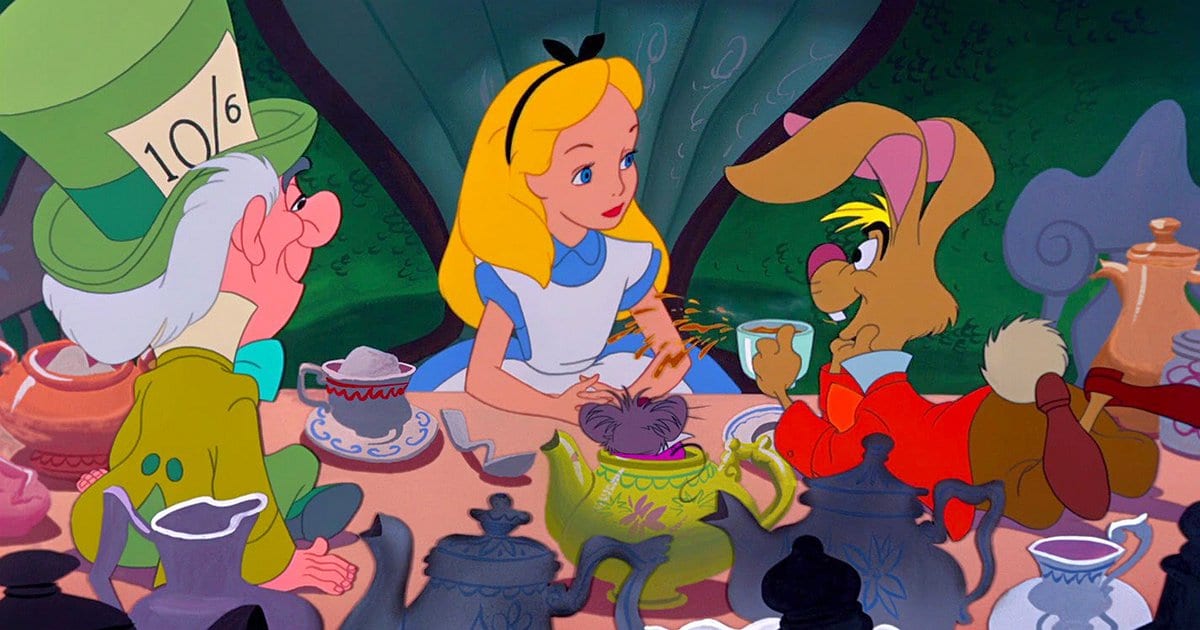
I think it would be fair to say that for many of us, our first exposure to Lewis Carroll’s Alice books was through the 1951 animated Disney film. Although it received middling critical reception at the time of release, the movie has since been vindicated as a classic, and is one of the most popular adaptations of Carroll’s text. In fact, the movie has for many people superseded the original text, at least in terms of the recognizable images that the public associates with the phrase ‘Alice in Wonderland’.

For most people, especially Americans, it is hard to disassociate the character of Alice from English actress Kathryn Beaumont’s stuffy and perpetually annoyed upper-class performance, or to separate the Mad Hatter from the cartoon’s bucktoothed little man who speaks with Ed Wynn’s distinctive vocal patterns. The phenomenon of an adaptation displacing the original in the public consciousness is extremely interesting to me. This is often brought up about Disney, and to be fair, their movies do often replace their source material in the minds of the public… after all, when was the last time you saw a version of Cinderella in which she received a dress from a tree enchanted by her mother’s spirit rather than a fairy godmother? But this happens extremely often with any adaptation of a popular book. In adaptation, things are added or removed, and many times people have seen the adaptation but not the original text.

Related image

My theory as to why elements from visual adaptations tend to stick in the public consciousness more than the books they’re based on do is that people remember visual images more than the images they conjure up when reading. In a way, movie adaptations do part of the work for you — Especially for a world as fantastic and otherworldly as Wonderland, it might be hard for a reader to conceptualize the images that Carroll describes. But in a visual medium, part of the work is already done for you. It might be a more passive form of consuming entertainment, but if the adaptation is done well, the images do line up well with what is described in the book.

Most colorized versions of John Tenniel’s illustrations of the Alice books depict Alice as being a blonde and wearing a light blue dress. The real-life Alice Liddell was a brunette, and some versions of the illustrations show Alice in a yellow dress, but for the most part, the blonde-with-blue-dress image is codified as Alice’s standard look. The Disney version used this version of Alice as their starting point, but other adaptations, such as the 1985 miniseries, have Alice in a yellow dress. Although he was not the only artist to take a crack at depicting the famous scenes in the books, Tenniel’s illustrations have become associated with the Alice books, and because of a derth of description in the text itself, most of our perception of what things looked like in the stories was informed by these illustrations along with the Disney film. In fact, Tenniel’s version of Alice has become so famous that in England, black headbands are often colloquially referred to as ‘Alice bands’.

Image result for john tenniel alice in wonderland

Wonderland and The Spirit World

Films and literature have a complex and ever-changing relationship. In modern day, it is common for a popular work to be translated into a movie/television series/book/etc. In literature and cinema, there is often a reoccurring idea of revision and interpretation. Whether it be a movie or a novel, it is inevitable for a work to not be recycled into something new, or re-vamped. This idea is extremely controversial. When misinterpreted, appropriation is likely. On the other-hand, if the interpretation matches, or even surpasses the original, the audience might favor the new work. This idea is evident in the different movie interpretations of Lewis Carroll’s Alice’s Adventures in Wonderland. Continue reading “Wonderland and The Spirit World”

Growing Up Within Minutes

As our class digs deeper into the meaning of Lewis Carroll’s Alice’s Adventures in Wonderland, we have briefly explored the moments in which he mentions Alice growing and shrinking. We have assumed that her height change is only associated with her consumption of different food and drinks. However, I have started to wonder if this theme is related to a feeling she has in life outside of Wonderland.

Throughout the book, it is easy to recognize that Alice often feels lost and unsure of why certain things are happening during her adventure. Things that she is unfamiliar with occur continuously, causing her to become confused about herself and her circumstances. In chapter two, she asks “who am I then?” Along with the changes occurring in her daily life, she begins to go through many physical changes. She is confused as to why she grows and shrinks whenever she consumes certain things. It is unclear to her why she cannot stay the same size. All of these drastic changes cause her to feel different, and she is unsure how to feel about this.

After studying this text, I have questioned if Alice’s desire to remain the same size in Wonderland was also true in her real life. After all, some children find it difficult to come to terms with the fact that they cannot remain a child forever. At the age of eight, children begin to recognize a shift in how they are viewed by others. It becomes clear that they must become more independent and deal with certain issues on their own. We see this in Carroll’s book when Alice is put into a new world without the guidance of an adult. It is up to her to find her way and make her own decisions, which is not something most children enjoy doing. It is likely that Alice was being encouraged to become more independent at the time her father wrote this book, which could have caused him to incorporate this idea into his story.

It is my belief that Carroll’s inclusion of Alice’s changing height in the story is influenced by her uncertainty of growing up. This idea is visible when it is stated that “she went on growing, and growing, and very soon had to kneel down on the floor: in another minute there was not even room for this, and she tried the effect of lying down with one elbow against the door, and the other arm curled round her head.” This quote makes the reader wonder if Alice is uncomfortable with the idea of growing up so quickly. Even though she grows within minutes of eating in the book, it is likely that she feels as though she is growing at a very fast pace in real life. 

Given that Lewis Carroll wrote this book for his daughter, Alice, it is quite possible that he included certain events that were relevant to her life at the time. Although he wrote about her growing in an abstract way, I believe this theme was influenced by her unease towards becoming older.

Changing Identity, Cultural Ownership, and Shrek

“We can learn a surprising amount from the most disturbing elements of our culture,” my roommate said as we discussed my idea for this blogpost. Over the course of the semester, we have considered how parodies, adaptations, and different versions of a text can change its identity as a whole.  I began to realize just how relevant this concept is to our daily lives, even in the peculiar case of “Shrek is Love, Shrek is Life.”

For those who are unaware, “Shrek is Love, Shrek is Life” is a series of YouTube videos originating from the image board 4chan.  The videos depict the DreamWorks character Shrek as a godlike figure who brutally murders multiple people and engages in obscene sex acts with a minor.  If you wish to view these videos for yourself, do so at your own risk.  After viewing them, it is near impossible to look at the original Shrek movies in the same light—which is my exact reason for analyzing “Shrek is Love, Shrek is Life” from this theoretical lens.

The lewd vulgarity of “Shrek is Love, Shrek is Life” is impactful to the extent that it changes our entire perception of Shrek as a character.  No longer is Shrek a simple ogre from a children’s movie; the internet has given him a new, larger, and twisted identity. Moreover, the “Shrek is Love, Shrek is Life” videos allude to numerous scenes and lines of dialogue from the original movie series, altering our perception of the films.  On a deeper level, their identity.  Is this a change for the better?  For fans of crude, offensive humor, possibly.  But for viewers who wish to enjoy the Shrek franchise as it was intended—an animated comedy film geared toward children—, certainly not.

Likewise, “Shrek is Love, Shrek is Life” forces us to question who holds true ownership over a text, film, or any cultural artifact.  DreamWorks holds legal and monetary ownership over the Shrekfranchise through copyrights and contracts, but perhaps these forms are nominal: there is evidently a much greater, collective cultural ownership of Shrek. With all its capital power, DreamWorks could alter the identity of its own creation; at the same time, a single individual using rudimentary computer animation in his basement seems to have the same power.  If the “Shrek is Love, Shrek is Life” videos prove one thing, it is that the collective is a strange animal.  The collective is not homogeneous.  When it comes to collective ownership of a cultural artifact, friction is a strong likelihood.  One faction of the collective, no matter how small, can alter the identity of an artifact and potentially ruin the experience of the rest of the group. Problematic?  Yes.  Avoidable? Not without infringing on the individual right to digest a piece of culture in one’s own unique way, which I see as imperative to academic discussion and greater societal growth. Though it may lead us down some disturbing paths—made apparent by “Shrek is Love, Shrek is Life”—, it is better than stagnation.

When Their “They Say…” Becomes Your “I Say”

Often in English when I think of the concept “they say… I say…” I think of a debate. There are two opposing sides, and although words might be similar the sides never seem to agree fully. I went to the event “All College Hour Speaker Series:  David Herd and Anna Pincus, Refugee Tales, “Art, Activism and Ending Detention”” for my anthropology class and listening to David and Anna speak lead me to think about a different type of “they say… I say…” that I often overlook.

David and Anna are a part of the charity known as Refugee Tales. They go and visit refugees in the United Kingdom. While they are visiting the refugees tell them their own story. Although the stories are often relayed to other listeners as an anonymous tale, these stories humble the listener and the refugee feels grateful and relieved that someone took the time to listen to their story.

The charity Refugee Tales does more than just listen to the refugee stories. They share them. They host walks like other charities; however, unlike other charities they don’t walk to take a stand or show support, they walk in solitude. The stories of these refugees are shared by the charity workers, yet they don’t do it in a way that tries to promote the charities voice or how amazing they are. They share these stories in a way that makes the listener hear the refugee’s voice. The goal of Refugee Tales  in “they say… I say…” terms is that the they say matches the I say exactly so what is said is simply the refugee’s story and not the charity’s story. They walk and share stories based on the idea set forth in Canterbury Tales.

So often I find myself wanting to argue when I think of the idea of “they say… I say…” yet this charity focuses on letting the “I say” of the speaker match as closely as possible the “I say” of the refugee. This idea made me think greatly about how sometimes your “they say…” and your “I say…” CAN agree. Sometimes your “I say…” simply expands on what “they say…”. It is by no means an argument

Although when we share another person’s story we don’t always think of it as what “I say” is sharing the story “they say”, that is precisely what we are doing. Whether we do it as part of a charity or just in conversation. When we share another person’s story we are making our “I say” what “they say”. This is important remember as we consider how many authors and speakers can have the same views. Our “I say” can match what “they say”.