
Physicality vs Substance

The ambiguity of identity is what makes it so convoluted in formulating a direct definition to encapsulate it’s core idea. The direct definition of identity is ‘the fact of being who or what a person or thing is’. However, that interpretation of identity leaves many blank spaces in the answer to our question; What actually is identity? Is it the state of being, or is it the narrative of being a physical entity.  We are given the idea that a person or thing is tied to a singular identity, however, when we change those circumstances, does it retain its identity?

In class, we briefly discussed the issue of identity in defining a book and whether it is the narrative of the book, or its physicality, that represents that definition. In Alice in Wonderland  by Lewis Carroll, questioning identity is a reoccurring and prominent theme. Multiple times, the story makes Alice and the reader question the reality of the situations. However, not all these questions of identity stem from Alice’s time in Wonderland. In the very beginning of the story, Alice and her sister were laying under a tree while Alice’s sister ‘read’ a book. “Once or twice she had peeped into the book her sister was reading, but it had no pictures or conversations in it, ‘and what is the use of a book,’ thought Alice ‘without pictures or conversations?'”. The purpose of the ‘book’  is not the focus of this blog post, but rather the definition of such object as a book. Is the identity of the book validated by the physicality of the material its made of, or rather the narrative its meant to have?

 The identity of the book in regards to the passage is ambiguous because of the lack of answer. the passage toys with the question because Alice leaves it open for interpretation. As we have seen from class, the answer to this is up to perspective.  Many people may side with the physicality of the book as what defines its identity, while some may side with the narrative. However, maybe identity should stay ambiguous. Let it be what it is.


Individuality and Acceptance

Going back all the way to the beginning of the semester, we had watched Hannah Gatsby’s Nanette that is featured on Netflix. Hannah Gatsby is an Australian comedian and has done shows many places around the world. Her performances are comic but also her Nanette performance had a little bit of a story.

While focusing on keeping her audience engages in her performance she tries to explain her difficulty of acceptance because of her sexuality. She talks about the hardships she had went through with her family and whether people in this world would still except her as the person she had become. Image result for hannah gadsby nanetteIf you may be interested in viewing Hannah Gadsby’s show I will put the link on the bottom of the blog.

Henry David Thoreau seems to also have this struggle. During his writings and the books of his that we read in class, you can predict that Thoreau has trouble accepting himself and seems to like being independent and not really care about anyones opinion or what they have to say. He decided that it would be better for him to live abroad from others at their pond named Walden. Reading the books from Thoreau you can identify by the words he uses that he is trying to find a sense of “serenity” from where his life had taken him. You can see that in Hannah Gadsby as well. She wants people to accept her and wants to find that sort of acceptance from others and a sort of “serenity”, not only with herself but also from her peers.

Identity plays a big part in both of these relationships. Hannah Gadsby’s identity may not have been what people were thinking of her and she is okay with the identity to go by and knows that no matter what her “identity” as an individual will never change, no matter what gender she prefers. Same goes for Thoreau. He knows that his identity will never change and people will always know him and the kind of person he is, no matter where he decides to reside.

Throughout the show from Hannah Gadsby, you can find yourself thinking “I can really feel for her, what she is going through with SEXUAL identity must be very difficult.” The books of Thoreau are a little different. Even though he is not struggling with a sense of sexual identity he is struggling with a sense of personal identity. He wants to find what suits him the best and what would make his life comfortable for himself and trying to find what Is best for him as an individual. Both struggle with a sense of identity but in different ways but it really makes you feel for the characters and compare it to your life as an individual as well.

https://www.netflix.com/watch/80233611?trackId=13752289&tctx=0%2C0%2C6203a046-6f5a-4f83-9cb3-e46a2a1f152b-92444741%2C%2C


The Lake Isle of Innisfree

Today in my Irish studies class, we discussed a very prominent Irish poet, W.B. Yeats. His famous poem, “The Lake Isle of Innisfree” was partially influenced by Henry David Thoreau’s “Walden.” The poem, written in 1888 is about a peaceful lake where Yeats imagines building a cabin to live in and enjoy the authenticity of rural Ireland.

Yeats lived in London which was very modernized in this time period. His poem recognizes the contrast of the different places (the lake and the city) when he talks about roadways and pavements that he stand upon, rather than the “bee-loud glade” he wishes he were at.

It’s interesting to see other writers inspired by the work of Thoreau, especially because we spent a long time reading and discussing the passages of “Walden.” I think it’s cool to see how the idea of returning to nature inspired this beautiful poem and continues to inspire me to write as well.

Alice’s Identity in Wonderland

Recently in my psychology class, we talked about adolescents dealing with their self-concept and identity. Self concept is a conscious, cognitive perception and assessment by an individual of themselves. Identity is defined as ones life story. Compared to identity, self-concept is more limited; identity is more complete, coherent, and forward projecting because it includes long-term goals.

Throughout Lewis Carroll’s book Alice’s Adventures in Wonderland, Alice is constantly confused about her identity. Alice is most likely experiencing an identity crisis. Her confusion begins after she becomes small and then big. She starts to question who she is. Alice tried to prove that she is still the same Alice by repeating her lessons-only to find out that she cannot say them correctly. As a result, Alice starts to go through her friends and decide which one she must be because she is obviously not Alice anymore. Alice decides that she is her friend Mabel, because she cannot remember her lessons. When Alice grows larger, she becomes confused about her age as well, stating that she’s “grown up now,” even though the only thing that changed was Alice’s size. She also experiences confusion when the caterpillar directly asks her “Who are you?” and she cannot seem to come up with an answer-not even her own name. Alice again confuses herself with someone else when the White Rabbit mistakes her for Mary Ann, his cleaning lady, and tells her to “fetch [him] a pair of gloves and a fan.”

Although Alice is not an adolescent, she is still struggling with her identity. Alice is having a tough time trying to figure out who she is and how she fits into society in Wonderland. Since she doesn’t understand the new world around her, she finds it harder to understand how this ‘new Alice’ fits into it. Alice even admits that “it was much pleasanter at home” but that Wonderland is “rather curious.” Although she is confused about herself and her surroundings, she can’t help but be intrigued. This confusion shows that Alice is not yet set in her identity and therefore is able to test different roles and identities until she finds one that fits her.

Baby Feminists

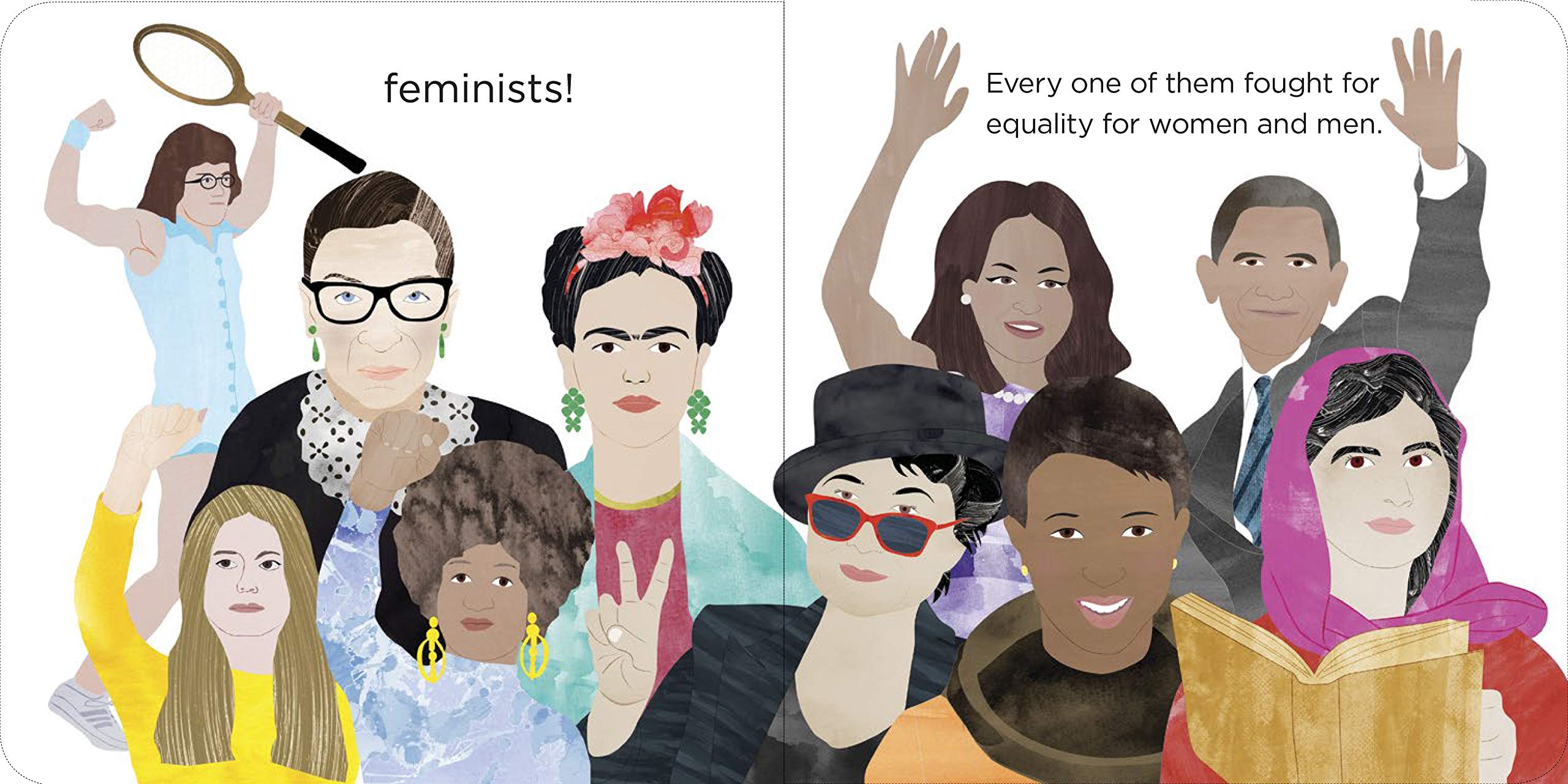
When perusing through a “mom and pop” style bookstore in my hometown of Buffalo, New York this past weekend, I stumbled across something that caught my attention. In the Children’s Books section sat a cardboard-clad picture book, titled Baby Feminists. Obviously differing from the typical children’s selections where, “the cow goes moo” and “the duck goes quack”, I had to pick up this book to see what it was all about. The first page went something like this: “Before she rose to the Supreme Court, Justice Ruth Bader Ginsberg was…”. To the right of this text was a caricature of the Notorious R.B.G. herself, on a slightly raised piece of cardboard, bound to be flipped up. That’s funny, I thought, what child would know who Ruth Bader Ginsberg is? I proceeded to flip over Ginsberg’s portrait to reveal an adorable cartoon baby Ruth depicted with cat-eye glasses and a gavel in hand. Incredibly delighted by this image of one of the most notable women in not only feminist, but American-judicial history, I continued on. Flipping through pages of other remarkable feminists, such as Dr. Mae Jemison, Frida Kahlo, Billie Jean King, Yoko Ono, and Barack and Michelle Obama, as well as many other trailblazers, I realized the true importance of this divine piece of literature. Definitely geared towards an audience of children about three years old and up (not actual babies), this book was intended to educate our youth about the significance of feminism before they are old enough to be corrupted by opposing views. This book was written with the intention that parents would read it to their children and explain what these icons did for the world of feminism. These educated children would grow with this important knowledge and would hopefully influence the way society in their future generation behaves in respect to the equality of men and women. I believe this book, as well as similar works, are incredibly vital to the prosperity of mankind. If children are taught important morals while they learn basics like how to read and write, even use the toilet and walk, these values would take just as much precedent as basic human functions. The book Baby Feminists written by Libby Babbot-Klein and illustrated by Jessica Walker is an incredible method of education for our little ones and I highly recommend checking it out the next time you stumble into the children’s book section!
Tuesday theme – Windmills of Your Mind

Our theme song today in ENGL 203-04 is “Windmills of Your Mind,” with music by Michel Legrand and lyrics by Alan Bergman and Marilyn Bergman. It’s performed here by Noel Harrison, who sang it as the theme to the 1968 movie The Thomas Crown Affair. “Windmills of Your Mind” won the Academy Award that year for Best Original Song. The title of the 2003 compilation album that includes this Harrison recording — Life is a Dream — suggests one possible connection between the song and our reading for today.

word choice

[His words are wisdom to those legislators who contemplate no essential reform in the existing government; but for thinkers, and those who legislate for all time, he never once glances at the subject. in RCG 36-45]he doesn’t really to seem to know the difference in what they are doing wrong so if there is an issue it is our job as human beings to educate others and make them aware of whats really going on. How will will we do this one may ask? My answer would be to make sure that we as the people who are supposed to abide by the laws to speak up when there is a valid reason to question them. The voice or speaker should not only be heard through the media as most people would do when they need something to be shared and reworded to sound better than it actually is. For example the media would sometimes make people seem greater or less than who they really are and use a higher vocabulary. [sojourner. Economy 1-14] This was said by a man that lived by himself for 26 months and was about a mile from his nearest neighbor in the middle of the woods. This shows that he is a person that uses his resources to survive while liking that kind of lifestyle he chooses to come back to a “civilized life” where he can communicate with others and share his experiences from living alone for a little more than two years. Word choice I would say is the most important when reading about the economy because everyone has a different experience with [In most books, the I, or first person, is omitted; in this it will be retained; that, in respect to egotism, is the main difference. We commonly do not remember that it is, after all, always the first person that is speaking. I should not talk so much about myself if there were any body else whom I knew as well. Economy 1-14] Sometimes using pronouns can change the way a story is told and create multiple meanings that either aren’t intended or are open for interpretation. The experience can also be frustrating and confusing but need to be done in order for people to know and understand.

Thursday theme – White Rabbit

Today’s theme song for ENGL 203-04 is “White Rabbit,” written by Grace Slick when she was a member of the short-lived group The Great Society, and performed by her here as lead singer of Jefferson Airplane. This version, recorded at the 1969 Woodstock music festival, is only slightly different from the one on the Airplane’s 1967 album Surrealistic Pillow but quite different from the Great Society’s 1966 live performance in San Francisco. If you’re in the mood for some mind-blowing retro psychedelic TV, you can also watch this 1967 TV performance on The Smothers Brothers Comedy Hour.

Among works that inspire what we’ve been calling follow-on creativity, Lewis Carroll’s Alice books are practically without rival. In his 1995 Lewis Carroll: A Biography (Knopf), Morton N. Cohen writes,

. . . neither Alice book has ever gone out of print. . . . Next to the Bible and Shakespeare, they are the books most widely and most frequently translated and quoted. Over seventy-five editions and versions of the Alice books were available in 1993, including play texts, parodies, read-along cassettes, teachers’ guides, audio-language studies, coloring books, “New Method” readers, abridgments, learn-to-read story books, single-syllable texts, coloring books, pop-up books, musical renderings, casebooks, and a deluxe edition selling for £175. They have been translated into over seventy languages, including Swahili and Yiddish; and they exist in Braille.
(pp. 134-35)

Continue reading “Thursday theme – White Rabbit”

Thursday theme – The Tyger

Today’s theme song for ENGL 203-04 is a musical setting of the English poet William Blake’s “The Tyger,” composed by Andrew Miller and performed here by the Concordia Choir.

Each of the poems we’re looking at today — including Blake’s “The Tyger” — exists in multiple versions. This is what makes them fluid texts. But what do we mean by a version? Continue reading “Thursday theme – The Tyger”

Tuesday theme – Autumn Leaves

Today’s theme song for ENGL 203-04 is “Autumn Leaves,” composed by Joseph Kosma, with French lyrics by Jacques Prévert and English lyrics by Johnny Mercer. It’s performed here on the theremin by Pamela Kurstin.

As the autumn leaves begin to turn here in western New York, our thoughts in “Fluid Readers, Fluid Texts” turn to leaves of a different kind: the leaves of manuscripts.

Why are they called “leaves,” anyway? What’s the connection between foliage and a folio? Continue reading “Tuesday theme – Autumn Leaves”