
What I found the most interesting in the poem Zulus in Percival Everett’s book re: f (gesture) is the use and inclusion of a variety of languages. In some of the stanzas, Everett included lines of romance languages such as Spanish, French, and Latin. I personally was only able to decipher one of the lines, the Spanish, without using a translator. Being fluent in more than one language in this country is most commonly thought of as unnecessary. However I think that in this poem, Everett is trying to show us how ignorant American culture is when it comes to knowing and considering other people’s cultures and languages.
Sex is Science
Today, in class we discussed the series of poems that make up Percival Everett’s Body. Within the work, Everett uses biological and scientific terms in order to describe a sexual encounter. He refers to body parts and processes by their scientific names which I found incredibly interesting and even a little unsettling.
I say unsettling because growing up, a large majority of children are taught that sex is a very intimate and beautiful thing. But in these poems, it is almost as if Everett is stripping away that intimacy and beauty and turning the act of sex into a very scientific thing. Which upon further reflection, I realized it kind of makes sense. When it all boils down, sex is science. All of the reasons sex is sex are scientific, whether it be the science of having a baby or the science of the pleasure of sex. Sex is science. Continue reading “Sex is Science”
People and Faces, People and Names
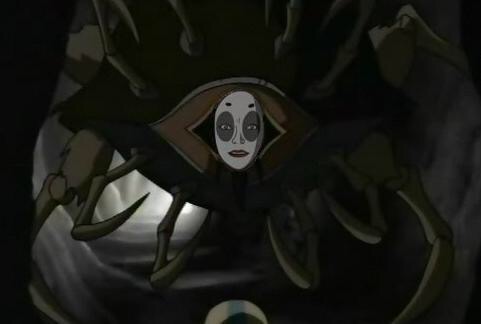
Across many cultures, names grant a sense of identity and individuality. One google of “why are names important?” returns many results, most of which explore various issues of identity coupled with a potential sense of otherness. I bring this up because the concept of the importance of names just doesn’t stop appearing in Percival Everett’s work. To quickly return to I am Not Sidney Poitier, consider Not Sidney. So much in his life occurs around his name, and it’s key in who he becomes as a person and what he does. It gives him a sense of individuality, but also otherness from the strange nature of his name. However, this post isn’t really going to focus on I am Not Sidney Poitier. Instead, I’m going to discuss names in the context of “Zulus”, a poem by Everett. Oh, and this guy:
How to Read
In the syllabus, one of the learning outcomes pertains to “what we should read, why we should read, and how we should read.” In this post, I will focus in on how we should read. While reading Everett’s poem “Zulus” I found myself trying to make connections between the different stanzas. After the initial reading we did as a group, it almost seemed as though each stanza was its own individual poem. A couple of my group members and I had to remind ourselves that no, this is not a collection of poems, this is simply one larger poem. “Zulus” is a poem that does whatever it wants, yet I instinctively attempted to categorize the stanzas into their own separate (but also connected) entities. I think it’s natural for our brains to want to make sense of things, and one way that I do this is by trying to see how things connect. While it is possible that Everett wrote this poem intending for it to be a grand combination of nonsense, I can’t help but try to understand what it all means. But when it comes to Everett’s work, this is a difficult feat.
The Power(lessness) of Words
Earlier this semester, Dr. McCoy wrote a blog post discussing the Everett quote that we are all likely very familiar with by now: “It’s incredible that a sentence is ever understood.” The quote is originally from Percival Everett’s novel, Erasure. While reading the novel would definitely provide me with some helpful context that I could use to better understand the quote, I still believe I am capable of comprehending the quote, though in a different way, allowing the circumstances of my own life to inform me in my understanding.
Of course, the quote was still relatable for me, even at the beginning of this semester since I have experienced my own share of miscommunication in many different areas of my life. From work to school to relationships, I have always aimed to both understand the words of others and make myself understood as well. This can be a challenging process and miscommunications can create awkward, uncomfortable situations. However, this semester the quote took on greater meaning for me, as I began to undertake new responsibilities and encounter and learn from new, original perspectives.
Who is it For?
A couple weeks ago, Dr. McCoy raised an important question about the 1963 film, Lilies of the Field:
“Who is this movie for?
While the question initially eluded me, I believe that I have reached an answer. Continue reading “Who is it For?”
Freedom and Constraint
I’ve been thinking about some of thoughtful responses and building-upons that emerged from the write-your-own-abecedarian poem exercise. At some level, that exercise was about both freedom and (some) constraint.
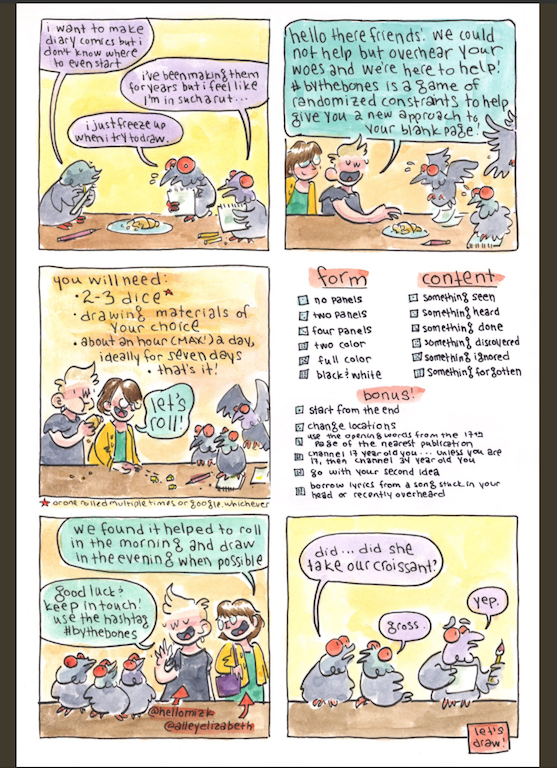
I’m sharing this graphic with you, which @hellomizk describes as follows:
#bythebones is a game of randomized constraints for anybody who wants to play with diary comics–whether you’ve been making them for years or have never tried but want to give it a go. Here are the instructions: please share widely and let’s draw!
h/t @savannahmillion, who along with @alexcox hosts Roboism, a podcast about how “robots, artificial intelligence, and machine learning are affecting our culture.”
The Author of Allusion
In my last personal blog post, I wrote about my admiration for Percival Everett’s work. Since I’m clearly obsessed with him, I thought that this is another great opportunity for me to unpack my thinkING one step further and stress the importance behind this author’s writing style. Not only does Everett discreetly write about social issues in his works, but he also has hidden meanings behind the structure of his stories as well. Let me explain. Continue reading “The Author of Allusion”
A different perspective
We were told that today would not be an easy day. We would be covering a heavy topic and if anyone wanted to take breaks during the lesson they were free to do so. We would be shown “some videos that will help set the literature in context, deepen our understanding of history, and bring us closer to linking feeling and thinking about what’s being done to humanity”(Beth McCoy, email).
Abstract and Explicit at the Same Time
Before coming into this class, I was incredibly unfamiliar with the term voyeurism. I had only heard the word a few times and could never truly define it. Now that I fully comprehend the word, however, voyeurism is following me everywhere.
Recently, in a different English class, I analyzed the novel Extremely Loud and Incredibly Close which involves the life of a young, autistic boy whose father passes away in 9/11. The book incorporates pictures taken on 9/11 and repeatedly uses the “falling man” picture. For those who are unfamiliar with this term, the “falling man” picture is an image that happened to capture a person jumping out of the world trade center to their death. Dr. Paku noted that some people saw these pictures as voyeuristic at the time, and that the photos sparked some controversy among the general public shortly after the terrorist attack. The term voyeurism had come back into my life! Until that day, I had never considered the idea of violent photos appealing as voyeuristic. However, it makes sense. For some odd reason, people are drawn to these photos. People want to know more about this act of terrorism. People are drawn to the mystery of violence.
A few blog posts ago, I discussed the voyeuristic nature of Norman Rockwell’s painting, The Connosseur. In her comments, Professor McCoy acknowledged the fact that voyeurism would reappear as a theme in future books, specifically abstract art, and that there was a potential for another blog post! Lo and behold, the cover of Percival Everett’s poetry book, re:f(gesture) is an abstract painting which, if studied close enough, could be perceived as a naked body of a woman. While that is how I perceived the panting, I fully recognize that others could see something completely different.
*explicit language warning